Showing posts with label learning outside school. Show all posts

Sunday, October 24, 2021

‘They’re just playing Minecraft.'

Dozens of students enter the library during both recess and lunch to play Minecraft. They walk in, laptops under their arms, often still chewing a mouthful of food that they hastily shoved in while walking from their class to the library. Their two 30-minute breaks are their time, to eat and use the restroom, sure, but mainly to continue their Minecraft gameplay. My colleagues in the library, and I, have all admitted on various occasions that we have no idea what is so enthralling about the game of Minecraft. The natural colour palette of greens, browns and blues looks pleasant enough, but to the untrained eye the ‘blocky’ gameplay of Minecraft is strangely reminisce of games circa 1990, and aren’t graphics meant to be, like, good, now? This apparent pixelated simplicity is where Minecraft’s real complexity lies and where it allows for unimaginable possibilities.


Minecraft Cube by Albin Olsson available under a CC BY-ND 3.0


Let’s talk about constructivism for a moment. Kuhlthau et al. (2015, p. 15) espouses the significance ‘engaging students in stimulating encounters with information and ideas’ to achieve deep learning. The literal construction embedded in the gameplay of Minecraft aligns with the elements of constructivism including being an active participant, reflection, and high levels of motivation (Kuhlthau et al., 2015, p. 15). There are several elements to consider at this point, firstly, that young people are able to play Minecraft minigames competitively, but Minecraft provides greater satisfaction through collaborative gameplay (Stuart, 2019, para. 9). Young people learn the skills required to play and create within the interface of the game and the adaptability and curiosity to play successfully, in many cases are aspects that transfer to different contexts. They also have an opportunity to be part of a team and all that encompasses—leadership, decision making, and compromise. 


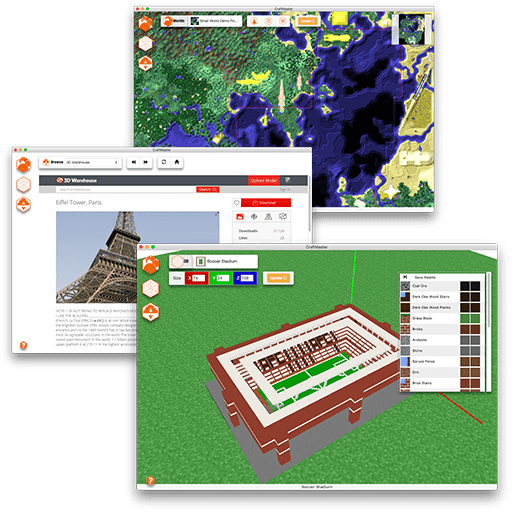
The library may be filled with students playing competitively, but they are also creating worlds, contributing to shared resources, collaborating, problem solving, and also, having a lot of fun in their breaks between classes (Kuhlthau et al., 2015, p. 19; Fiske, 2010, p. 41). Minecraft offers a realm of possibilities as far as the gameplay and world creation goes. It is possible to design avatars and build all kinds of objects and places in creative mode and this is where it becomes a useful tool for school—we may not be able to attend a play during a pandemic, but Minecraft Education can give students the opportunity to build The Globe Theatre (Farber, 2016, para. 4). The level of skill required to build a real-world location in Minecraft is immense and would be an ideal task for a team of students (Fiske, 2010, p. 45). Consider how well this concept fits into the constructivist model of learning—active engagement in the learning process, building on what they have learnt in class and conducting further research, problem solving, collaborating with peers, and ongoing learning through the experience of adapting a real-world location into the game (Kuhlthau et al., 2015, p. 15). 


CmScreenshotsComp512px by Glitchunpatched available under a CC BY-ND 3.0


The convergence of media is evident in the way that Minecraft has transformed from its original ideation on PC to be a popular platform across many gaming consoles as well as populating video hosting sites like YouTube (Buckingham, 2016, pp. 78-79; T. Porter, personal communication, October 24, 2021). The way that it combines competitive gameplay with world creation also places it within the realm of convergence which is to say that it offers such broad experiences to users (Buckingham, 2016, p. 79). I spoke to my nephew for to fine tune my understanding of the game and it was evident, that the way that young people play the game depends greatly on the device they are using as there are different editions for PC, Xbox, Switch, and even mobile devices (T. Porter, personal communication, October 24, 2021). He assured me that there were positives and negatives of each, and he told me of his preferences given the technology he has available to him and what his parents allow him to use. I got a sense that Minecraft in both a literal and figurative sense fits into the ‘sandbox’ description with the capacity for individualised and creative gameplay (Chapman, 2011, para. 1: Kuhlthau et al., 2015, p. 15).


Now, the nitty gritty… could our kids get into strife while playing Minecraft? Let’s start with the cost. There is a one-off cost to purchase the game but there are some limitations in that, on some platforms, this does not allow a user to play with friends. For this to happen (and again, some of this information does depend on what console the game is played on), a subscription must be purchased and alongside access to regular game play, a server is provided, and this how one hosts games for others. An added benefit of a server is parental controls and there is an extra layer of modification possible as the user who holds the server is also able to set the in-game rules. The subscription fee could be prohibitive for many. The way that many young people access Minecraft is via accounts set up for school. For students with an Office365 account, Minecraft Education is available for free. Students will then have the opportunity to participate in learning-based maths and coding games and the freedom to use the subscription to build worlds and play with friends, beyond the scope of school assignments (Fiske, 2010, p. 44; Bowen, 2020, para. 3). 


Overall, the level of safety within the Minecraft platform really stood out to me, and I really did try to poke holes into the armour (there must be a LOT of enchants at work – that’s a Minecraft joke!). Young people with access to the game may play as individuals, with friends nearby, or online but even when they are online there are chat filters, parental controls, and ways to block other players which hopefully means the only baddies are those in-game – like ‘mobs’ of spiders, zombies, creepers (which, according to my nephew were actually first designed as pigs but there was a glitch, but they were kept in the game as Creepers. I was told to compare images of the two to see for myself—I have included the link below!) (T. Porter, personal communication, October 24, 2021; Mobs in Minecraft, 2011, para. 6). It is possible to report those who are not engaging in an appropriate manner, but I will reiterate, I am not naïve to think that every single member of the Minecraft community has only the best interests of fellow gamers in mind (Dowdall, 2009, p. 45). Being mindful of teaching moments around online safety would be useful.


SealbudsmanFace by SealbudsMan available under a CC BY-ND 3.0


The world building simply for the pleasure of creating is really highlighted in the create mode of Minecraft and the cognitive processes used for designs make it more than just a game (Fiske, 2010, p. 45; Johnson, 2005, p. 9). Considering the skills required of young people during competitive modes of  survival, minigames, and hardcore (this is when you have one in-game life, only!) as well, to determine what materials they need, to build shelter, find food, cook food, monitor their health, and build their in-game skill levels so they are able to strengthen their belongings with enchants, and the like, I think recess and lunch could be spent in worse ways!


Here are some questions you could ask to generate conversation about Minecraft:

  1. What do you call yourself in Minecraft? Why did you decide upon this name?
  2. What does your avatar look like? Have you ever downloaded a new ‘skin’?
  3. Do you ever play competitive Minecraft? What do you like about this mode of gameplay?
  4. Have you built any worlds in Minecraft? Are these from your imagination or are they based on real places?
  5. What is the most difficult thing to do in Minecraft?
  6. What do you enjoy most about Minecraft?
  7. What is the most annoying thing about Minecraft?
  8. Who are your favourite people to collaborate with in Minecraft? What do you each bring to the team?
  9. If you could change one thing about Minecraft, what would it be?
  10. How is playing at night, in the game, different to the daylight hours? Do you often make your avatar sleep through the night or are you on the lookout for monsters?
  11. Do you chat to friends while playing Minecraft?
  12. What is your favourite material to mine, in the game?
  13. If someone younger than you is about to sign up to play Minecraft, how would you teach them to be safe while they play?
  14. What would you rate the game out of 10? Who would you recommend the game to?
  15. Summarise Minecraft in three words.

A little bit of help if you have no idea what this post is about:

What is Minecraft?


Minecraft Differences Between Creative, Survival, and Hardcore Game Modes


Mobs in Minecraft (these are the in-game goodies, and baddies)


Minecraft Skins


How Minecraft Creepers Originated From A Pig Accident 


Minecraft at 10: a decade of building things and changing lives


Common Sense Media - Minecraft


And a few (actually, there’s a lot…) Minecraft items for those who need a gift idea (there’s even books!):


Big W


Target


Kmart


Reference List

Bowen, R. (2020). A Look At Minecraft: Education Edition & How To Play. Moms. https://www.moms.com/minecraft-education-edition-details/ 


Buckingham, D. (2013). Beyond technology: Children's learning in the age of digital culture. Polity Press.


Chapman, D. (2011). Minecraft. https://www.commonsensemedia.org/game-reviews/minecraft 


Dowdall, C. (2009). Masters and critics: Children as producers of online digital texts. In V. Carrington & M. Robinson (Eds.), Digital Literacies: Social learning and classroom practices (pp. 43-61). Sage.


Farber, M. (2016). 3 Ways to Use Game Based Learning. Edutopia. https://www.edutopia.org/article/3-ways-use-game-based-learning-matthew-farber 


Fiske, J. (2010). Understanding Popular Culture. Routledge.


Johnson, S. (2005). Everything Bad Is Good For You: How Today’s Popular Culture Is Actually Making Us Smarter. Riverhead Books.


Kuhlthau, C. C., Maniotes, L. K., & Caspari, A. K. (2015). Guided Inquiry; learning in the 21st Century (2nd ed.). Libraries Unlimited.


Mobs in Minecraft. (2011). Minecraft101.net. http://www.minecraft101.net/r/mobs.html 


Stuart, K. (2019). Minecraft at 10: a decade of building things and changing lives. The Guardian. https://www.theguardian.com/games/2019/may/18/minecraft-at-10-building-things-and-changing-lives 

Saturday, October 23, 2021

‘He is on the computer, again!’

This is the typical refrain that I hear from my in-laws about what their 12-year-old son has been up to and when I ask, ‘What is he doing on the computer?’ in unison they reply, ‘nothing!’ It got me thinking… if someone saw me on my computer and said that I was doing ‘nothing’ that would make me feel rather inadequate as if the hobbies and activities that were interesting to me were not worth talking about. With some probing I was able to determine what my nephew was actually doing on his laptop which was (J. Mulcahy, personal communication, October 9, 2021): 

  • adding a voiceover to gameplay and uploading machinima to his YouTube channel
  • interacting with friends
  • playing Minecraft 
  • playing Roblox
  • creating items for his Roblox avatar

The idea that these activities are ‘nothing’ highlights perhaps what is a clash of value systems and a misunderstanding of the complex skills needed to execute any of the tasks required to create online content and engage in online game play (Johnson, 2005, p. 11). My students play Roblox, too, and the above interaction was enough to give me pause. I regularly speak to students about the books they read, but as for those who are playing computer games, I haven’t felt knowledgeable enough to have a meaningful conversation. On reflection I realised I have work to do – I certainly haven’t read every book in the library but I can talk about books, why can’t I be adjacent to other forms of media? My bias exists, and henceforth I have conducted some research on Roblox, and I will follow up this post with other areas of interest including Minecraft, social media, books aimed at teenagers, and just in case you are out of your depth like me and my in-laws, some suggested conversation topics to get you up to speed with your children or students wiling away the day on their favourite game, social media app, or reading a YA novel. 

"Isaac's Island in Roblox - Animal Crossing clone" by avlxyz is licensed with CC BY-NC 2.0. To view a copy of this license, visit https://creativecommons.org/licenses/by-nc/2.0/

Isaac's Island in Roblox - Animal Crossing clone by avlxyz available under a CC 2.0


Before we embark on an overview of Roblox, let’s start with the concept of ‘pull media’ (Buckingham, 2013, p. 77). The design of modern media, including video games, falls into the category of ‘pull media’ with high levels of engagement, a non-linear structure, and interactivity that has led to the creation of a space that is vastly different to the monologic media forms of the past. I guess this is where many of us get the ‘heeby jeebies’ – kids talking to other people while they play games? They’re in a game with 28 random individuals? Peeps, the days of Yoshi and Mario on Nintendo Gameboy and DS are well and truly, over, (well, I’m holding on tightly to my DS). To highlight the difference, Buckingham (2013, p. 77) refers to older forms of media, like television, as ‘push media’ which directs content at the user. Roblox is ‘pull media’ in that it gives space for the user to choose when and how to engage, it requires input in terms of the creation of an avatar and responsive game play, and there is an ongoing interaction between players and creators. The morality judgement about the value of online gaming devalues the way many young people spend their time (Johnson, 2005, p. 14). Just because it isn’t the same as how we spent our time doesn’t mean it is a corrupting influence.


Roblox is both a user plays, and user creates model of platform but there is not necessarily more ‘value’ in either mode. There are various appeals for young people in the ‘play’ mode—designing an avatar (what a great way to capture aspects of their identity online (Jenkins, 2016, p. 31)), accruing items and in-game currency, ‘Robux’ (which I will elaborate upon in a moment), seeking out the games of favourite creators, playing a particular style of game, and really there is a ‘give and take’ notion of contributing to a data set for the game creator by providing feedback about elements of the game. The ‘creator’ side of the game really highlights Dowdall’s (2009, pp. 44-45) exploration about the constructivist nature of content creation and the power of learning outside the realms of formalised schooling. When creating within Roblox, a user may design entire games that start with a simple walkthrough to entire worlds. Experienced players with time on their hands can be very successful in this space and really, the only limit is their imagination (J. Mulcahy, personal communication, October 23, 2021). The affordances of the platform are developing alongside the expertise of users keeping it ever engaging with new content and options (Buckingham, 2013, 77). Roblox also allows the development of items like clothing for avatars within the platform which can then be offered to other players for purchase (J. Mulcahy & A. Mulcahy, personal communication, October 23, 2021). The sophisticated skills required to inhabit the realm of Roblox in both player and creator mode highlights the inherent value of the platform where young people can be immersed and engaged in a space while learning a range of skills that transfer to use in other contexts (Johnson, 2005, 9; Kuhlthau et al., 2015, p. 19).


Established in 2006, the game, according to YouTuber, I Am Your Target Demographic (2021, 3:56), has had a rush of popularity in response to the lockdowns required during the global health pandemic as it allows young people to stay in contact with their friends as they are able to chat while they play. Roblox has various parental controls available so the game can be locked down like ye’ old Yoshi and Mario, or players can be allowed to chat with other young people who they may know from school or extra-curricular activities. The interactivity offered requires young people to conduct themselves via a complex social contract in both communication and play as various games require collaboration and items may be traded (Jenkins, 2016, pp. 27-28; Johnson, 2005, p. 9).  Roblox currently offers a text chat function, but voice chat is a feature that will be released imminently to make this feature even more immersive (J. Mulcahy, personal communication, October 23, 2021). 


The joy that the game brings to users is not to be diminished but it is also a space where creativity and the skills required to create games and items, are honed alongside complex social interactions around trades of animals in ‘Adopt Me’ style games, and financial literacy required to manage Robux (I Am Your Target Demographic, 2021, 2:30; Fiske, 2010, p. 41). Beyond what is a range of positive aspects we should remember that Roblox is a business, and there are things of which we must be mindful. Roblox is a ‘hosting’ site like social media and YouTube, that stores user generated content, and it is a company, not an altruistic non-for-profit platform for tweens to chat to their friends. The nefarious side, of course, is that there is money to be made. While there is plenty of free content available to players, and some in-game currency is generated through game play and events, real bucks are required to purchase ‘Robux’ and this ups the ante on game play (A. Mulcahy, personal communication, October 23, 2021). Monthly subscriptions are available so players can make in-game purchases and it is these virtual belongings that make money for creators – if someone creates a game, they can embed items throughout the game that must be purchased to continue or to engage in the game in some way. Mind, though, that it is not just the creator who benefits from the sale of goods within the game. Roblox takes a 30% cut (CNBC, 2021, 3:32). To buy 100 000 in game Robux costs $1000 but selling 100000 back to Roblox? Well, that will earn just $350 and there is also a fee to withdraw real world dollars (D’Anastasio, 2021, para. 9). It seems that Roblox is definitely earning the big bucks.


Anyone who has children to buy a gift for rather appreciates the process of transmediation of which Roblox has taken full advantage. There is a range of books, action figures, and gift cards available in amounts of $10, $25, and $50 allowing users to buy in game Robux. Gift cards may offer a discrete way of allowing players to purchase in game rather than connecting a real-life credit card to an account. I did type ‘Is Roblox suitable for a 12-year old’ and landed on the expected ‘moral panic’ listing the dangers of the game (Jenkins et al., 2016, pp. 24-25). I just wanted to say, yes, Family Zone (2021, para. 7), the internet, and specifically, online fames, like any ‘room filled with strangers’ could harbour shady characters but real world, or online world, the stranger danger rules apply. We teach our young people to be careful in public places and this is just a little reminder, to continue such lessons so our young people are able to interact safely, while saving some of their pocket money, in the online world of Roblox.  


Roblox gift card in a hand over gift cards background by Gifty Cards available under a CC 2.0


Here are some questions you could ask to generate conversation about Roblox:

  1. What does your avatar look like? Why have you decided on that outfit and features?
  2. Have you ever made any items for your avatar? What have you made? Would you consider making some?
  3. How long did it take you to make the items? What kinds of skills do you need to make things for the game?
  4. What are your favourite types of games in Roblox?
  5. Do you have a favourite game creator?
  6. Have you ever created a game? What was the most exciting part of creating your own game? What was the most challenging?
  7. What do you like most about Roblox?
  8. What do you like least about Roblox?
  9. What do you think about Robux? Is it better to play with some Robux in your account? Can you have just as much fun without Robux? 
  10. Do you communicate with your friends during game play? What is the best game experience you have had with friends?
  11. Have you played a Roblox Event? Have you won any event items? 
  12. Have you traded any items in Roblox? How did you go about making sure the trade was fair?
  13. If someone younger than you is about to sign up for a Roblox account, how would you teach them to be safe while they play?
  14. What would you rate the game out of 10? Who would you recommend the game to?
  15. Summarise Roblox in three words.

Check out the transmediation stockists… (Now that I have a bit more of a clue, I will likely be buying a few gift cards for my nephews to thank them for their help with writing this post!).


Popular retailers:


Big W


Target


EB Games


JB HI-FI


A little bit of help if you have no idea what this post is about:


What is Roblox? Why do people play it?


2020 Roblox Trailer


2019 Roblox Trailer


How Roblox Became A $30 Billion company


Common Sense Media - Parents' Ultimate Guide to Roblox


Reference List


Buckingham, D. (2013). Beyond technology: Children's learning in the age of digital culture. Polity Press.


CNBC. (2021, February 13). #CNBC How Roblox Became a $30 Billion Company. [Video]. YouTube. https://www.youtube.com/watch?v=xXV9RV0s5pA 


D’Anastasio, C. (2020). On Roblox, Kids Learn It’s Hard to Earn Money Making Games. Wired. https://www.wired.com/story/on-roblox-kids-learn-its-hard-to-earn-money-making-games/ 


Dowdall, C. (2009). Masters and critics: Children as producers of online digital texts. In V. Carrington & M. Robinson (Eds.), Digital Literacies: Social learning and classroom practices (pp. 43-61). Sage.


Family Zone. (2021). Roblox: What parents must know about this dangerous game for kids. Family Zone. https://www.familyzone.com/anz/families/blog/roblox-parents-review 


Fiske, J. (2010). Understanding Popular Culture. Routledge.


I Am Your Target Demographic. (2021, April 8). I Am Your Target Demographic – What is Roblox? Why do people play it? [Video]. YouTube. https://www.youtube.com/watch?v=YU2pLJiptzA


Johnson, S. (2005). Everything Bad Is Good For You: How Today’s Popular Culture Is Actually Making Us Smarter. Riverhead Books.


Kuhlthau, C. C., Maniotes, L. K., & Caspari, A. K. (2015). Guided Inquiry; learning in the 21st Century (2nd ed.). Libraries Unlimited.