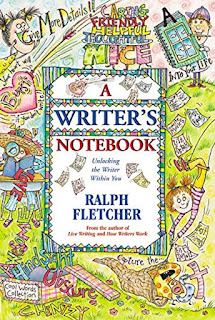
1. A Writer's Notebook by Ralph Fletcher
'Writers are like other people, except for at least one important difference. Other people have daily thoughts and feelings, notice this sky or that smell, but they don't do much about it.'
'A Writer's Notebook' is book supporting the development of a writer's notebook. Fletcher provides many useful gems in this book and it doesn't matter that it us aimed at upper primary school children - good ideas are good ideas. Fletcher has written several books supporting the writing process and he wrote my favourite article about writer's notebooks here.
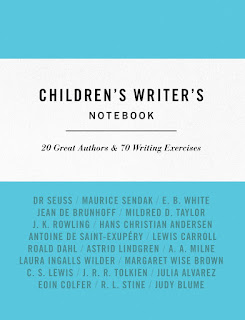
2. Children's Writer's Notebook by Wes Magee
This is a marvellous text is filled with writing prompts that relate to the work of a range of children's authors. The activities are straight forward but undertaking them will force your writing into a new direction. It is possible that the responses to the exercises will never leave the pages of your notebook but you will gain through attempting them and you never know, you may uncover a brilliant story!

2. Children's Writer's Notebook by Wes Magee
This is a marvellous text is filled with writing prompts that relate to the work of a range of children's authors. The activities are straight forward but undertaking them will force your writing into a new direction. It is possible that the responses to the exercises will never leave the pages of your notebook but you will gain through attempting them and you never know, you may uncover a brilliant story!

3. Creative Writer's Notebook by John Gillard
The 'Creative Writer's Journal' is just like the 'Children's Write's Notebook' and I leapt at the chance to buy a copy (it is pay week this week, right?!). This text provides a range of prompts drawing on a range of well known authors - check out the list on the cover. The prompts encourage movement from the style and subject matter your writing usually takes and they also give great insight into how you may respond to other texts and authors in the future.

4. Bird by Bird by Anne Lamott
Words and writing are what paint and canvas are to a fine artist, a way to interpret and see the world and in Lamott's case, when struggling to find her place as a teenager, to gain some acceptance. The power of story is evident throughout the book.

5. Write Every Day by Harriet Griffey
A straight forward text that focuses on the writing practice and a range of specific forms of writing. Griffey provides an overview of prose, poetry, and memoir as well as mechanical aspects like voice, dialogue, character, plot, and structure. The writing quotes are my favourite - I was able to find a few more texts on writing via the included quotes. Sample pages are available at the link.

6. Making Stories by Kate Grenville and Sue Woolfe
How great is print on demand? Making Stories was published in 2001 and while that feels like yesterday, it is 19 years ago which is a long time for a book about Australian writing to remain in print (or print on demand!). I was able to order a copy recently and I am eagerly anticipating its arrival. The book captures the drafting process - I think this offers an important insight into the writing process. The strength of a piece of writing is in ruthless revision.

7. The Artist's Way by Julia Cameron
The Artist's Way is a way to be introspective about the writing process and what is holding you back. It is presented as a 12-week course with some reading and activities to work through the development of the creative self. The renowned 'Morning Pages' originate from Cameron's work and are a worthwhile component of the book - three A4 pages each morning can break down a creative block and help find clarity with a writing project.

8. The Joy of Mindful Writing by Joy Kenward
A beautiful book that will easily fit into a laptop case, handbag, or maybe even a pocket. There are a range of 'Mindfulness' Exercises included as well as writing examples which makes it an excellent text to prompt and inspire writing outside one's comfort zone. Also, this would be a great book to support HSC English Standard and Advanced Module C: The Craft of Writing (always thinking about how things would work in the classroom!).

9. A Writer's Book of Days by Judy Reeves
Oh, this one is another nice one. There must be a particular sentiment from writers who write about writing that the book they write must be printed on nice paper or have a unique aesthetic. I am very much on board with this. Reeves' book is printed on cream coloured paper with burgundy writing. It includes advice on the writing process as well as a prompt for every single day of the year. If stuck, this could be the perfect remedy to get writing on a regular basis. There is even a section on writer's notebooks (pp. 19-20) which, of course, I was interested in. Reeves includes advice from the greats and the quotes and references she included have led me to some great resources.

10. Writing from the Senses by Laura Deutsch
Another relatively short book that highlights the impact of sensory writing. There are writing prompts, tales, and advice throughout this book all aiming to encourage the writer to find inspiration in their surroundings. I think the prompts would be great for a writer's notebook.

Happy reading, and writing!
N.B Images are the author's own and further information on each title can be found at the hyperlink - mainly Booktopia, for consistency's sake.

Happy reading, and writing!
N.B Images are the author's own and further information on each title can be found at the hyperlink - mainly Booktopia, for consistency's sake.


