Showing posts with label Teach. Show all posts

Saturday, May 30, 2020

A Writerly Life - Suggested Texts for Writing Inspiration 3/4

A book about the writing process is a thoughtful and I think, useful way to mull over one's writing progress. I have compiled a list of books about writing that I love. I buy books in this genre often and I am always reading one from my collection. The books included in this list have prompts for writing, advice around getting words on the page, how to approach the mechanical aspects of writing, developing a writer's notebook, responding to texts, and general guidance for developing a writing routine.

1. A Writer's Notebook by Ralph Fletcher
'Writers are like other people, except for at least one important difference. Other people have daily thoughts and feelings, notice this sky or that smell, but they don't do much about it.'

'A Writer's Notebook' is book supporting the development of a writer's notebook. Fletcher provides many useful gems in this book and it doesn't matter that it us aimed at upper primary school children - good ideas are good ideas. Fletcher has written several books supporting the writing process and he wrote my favourite article about writer's notebooks here.
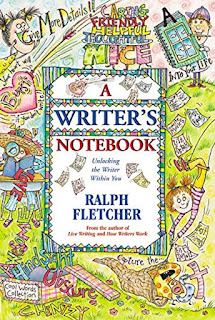


2. Children's Writer's Notebook by Wes Magee
This is a marvellous text is filled with writing prompts that relate to the work of a range of children's authors. The activities are straight forward but undertaking them will force your writing into a new direction. It is possible that the responses to the exercises will never leave the pages of your notebook but you will gain through attempting them and you never know, you may uncover a brilliant story!
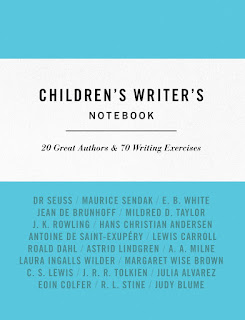

3. Creative Writer's Notebook by John Gillard
The 'Creative Writer's Journal' is just like the 'Children's Write's Notebook' and I leapt at the chance to buy a copy (it is pay week this week, right?!). This text provides a range of prompts drawing on a range of well known authors - check out the list on the cover. The prompts encourage movement from the style and subject matter your writing usually takes and they also give great insight into how you may respond to other texts and authors in the future.


4. Bird by Bird by Anne Lamott
Words and writing are what paint and canvas are to a fine artist, a way to interpret and see the world and in Lamott's case, when struggling to find her place as a teenager, to gain some acceptance. The power of story is evident throughout the book.


5. Write Every Day by Harriet Griffey
A straight forward text that focuses on the writing practice and a range of specific forms of writing. Griffey provides an overview of prose, poetry, and memoir as well as mechanical aspects like voice, dialogue, character, plot, and structure. The writing quotes are my favourite - I was able to find a few more texts on writing via the included quotes. Sample pages are available at the link.


6. Making Stories by Kate Grenville and Sue Woolfe
How great is print on demand? Making Stories was published in 2001 and while that feels like yesterday, it is 19 years ago which is a long time for a book about Australian writing to remain in print (or print on demand!). I was able to order a copy recently and I am eagerly anticipating its arrival. The book captures the drafting process - I think this offers an important insight into the writing process. The strength of a piece of writing is in ruthless revision.


7. The Artist's Way by Julia Cameron
The Artist's Way is a way to be introspective about the writing process and what is holding you back. It is presented as a 12-week course with some reading and activities to work through the development of the creative self. The renowned 'Morning Pages' originate from Cameron's work and are a worthwhile component of the book - three A4 pages each morning can break down a creative block and help find clarity with a writing project.


8. The Joy of Mindful Writing by Joy Kenward
A beautiful book that will easily fit into a laptop case, handbag, or maybe even a pocket. There are a range of 'Mindfulness' Exercises included as well as writing examples which makes it an excellent text to prompt and inspire writing outside one's comfort zone. Also, this would be a great book to support HSC English Standard and Advanced Module C: The Craft of Writing (always thinking about how things would work in the classroom!).


9. A Writer's Book of Days by Judy Reeves
Oh, this one is another nice one. There must be a particular sentiment from writers who write about writing that the book they write must be printed on nice paper or have a unique aesthetic. I am very much on board with this. Reeves' book is printed on cream coloured paper with burgundy writing. It includes advice on the writing process as well as a prompt for every single day of the year. If stuck, this could be the perfect remedy to get writing on a regular basis. There is even a section on writer's notebooks (pp. 19-20) which, of course, I was interested in. Reeves includes advice from the greats and the quotes and references she included have led me to some great resources.


10. Writing from the Senses by Laura Deutsch
Another relatively short book that highlights the impact of sensory writing. There are writing prompts, tales, and advice throughout this book all aiming to encourage the writer to find inspiration in their surroundings. I think the prompts would be great for a writer's notebook.


Happy reading, and writing!


N.B Images are the author's own and further information on each title can be found at the hyperlink - mainly Booktopia, for consistency's sake.

Saturday, April 18, 2020

Reflections on Week 10, Term 1, 2020

Week B is usually my 4-day week but I don't think such a thing exists anymore - not with the constant pinging of notifications from my students and my clearly terrible instructions that no-one is able to understand and even though we don't have class today, because I don't usually work today, they were just coming at me all day. I will have to manage this differently next term. I cannot cope with the barrage and the constancy.

My colleague found an amazing article to share with our Year 12 Standard English classes recently 'We are using the same words but are we speaking the same language?' and the words of the writer are echoing around my brain. They ring true.

So what has the past week been like? We are currently on a rotational roster of supervision so we only need to go in 1-2 times in the last two weeks of term. I also went in Monday and smashed out numerous things on the to list, one of which was organising copies of the modified assessment, and then getting modified criteria printed up and put into envelopes after organising a system for record keeping marking online. I drew up a timetable for the meetings and then we had the meetings all day Wednesday and then on Thursday the decision was made to cancel all junior assessment. The guilt that swallowed me - wasting all that time on Monday and Wednesday - is massive. This time period is hard enough and there's so little extra to give and I just worked for nothing and made my staff work for nothing. Not much can be done now but I am sad about it.

I have been collecting data and trying to work out a way forward that is not going to burden the staff in my faculty. I really do need to go into school to speak with the senior executive to clarify some aspects of online teaching because if I am feeling the pressure with four classes, what are my staff dealing with when they have five or six classes?

I have asked for an extension for my university assignment - it is due in 5-days and they are giving students whose workload has been impacted by Covid 19 an extra 5-days. I watched the census date drift by and paid the course fee so I am committed but I am so distracted. I am looking forward to pressing 'submit' but it is going to be a struggle to get there.

I just organised priority delivery for my grandmother so she is able to get supplies. My brother and sister in law recently visited her and mentioned that she was out of toilet paper - something she didn't mention to me so I need to put something in place to ensure she has the things she needs. I will call her local fruit and veg store to get them to do a delivery for her as well. If she has been living off her freezer store she will be missing fresh fruit and vegetables. It is times like these that I do wish I lived closer - not because I would go visit but just so I could shop for her and leave things on her doorstep.

I hope this is all over soon.

Thursday, April 16, 2020

Reflections on Week 9, Term 1, 2020

Week 9 was one of the biggest weeks of my career. Not for any reason worth celebration but because we systematically, in the space of 7 days flipped education from face to face to online. We all had a crash course in Google Classroom and we are, almost, officially online.

I have been working enormous days and caring for my partner and child while getting everything established. I joked, and I regret this now, that I would appreciate a little break to catch up on everything because I was tired. While there is a break from face to face teaching time now, the alternative, our online 'revolution' seems almost like I am shouting into a void and as for spare time. There's none of that.

I have modified assessment for 7-12 and have converted everything so it works on Google Classroom and students will be able to hand in their tasks online. Instructions have been written, hundreds of Google Classrooms notifications received and it is safe to say that this situation is less than idea. 

We are contacting families next week to ensure students are accessing materials. I really, really hope that maybe after a few days off last week that students will now get online to access materials and get on with the work I have put together. 

A few parents have asked to be part of the classrooms which I have no problem about, especially now that everything is set up and ready to go. I wasn't happy to add them last week when I was still trying to work out how to use Google Classroom but now, I am feeling a bit more confident.

I have made a few errors - using Google Forms to collect information for an assessment task. Forms makes information so easily collected, however, it also dumps the information in one area. When staff are marking their own classes this is not helpful - now everyone is going to have to flick through all of the student responses to find their own. Class lists are arbitrarily organised so it is not possible for me to collate the information into classes without sitting and doing it manually. I just do not have the time or mental capacity to do that at the moment.

The future looks interesting and I am not sure I am ready.

Sunday, April 12, 2020

Reflections on Week 7, Term 1, 2020

What a massive week.

Tuesday night was Open Night - I used to have a short PowerPoint quiz with ten questions about the subject of English but they reduced the time they wanted parents and prospective students at each station so my team rallied and put together a little display and I basically yelled at bunches of parents who tried to listen over the fray of other faculties. I had no idea just how many people would attend - in my before stint as HT there would be about 20 people in a large group but the groups this year were around 40+. I should have set up on the other side of the Library instead of across from another faculty because it was wild. I noticed some lose interest and walk off which is really disheartening and possibly problematic for the school. I did have a few good conversations though. I spoke about the daily poem in Year 7, the focus on giving time to reading and writing, opportunities for students to engage in writing competitions, extra-curricular activities such as debating and public speaking. I had a whole bunch take one of the poetry booklets I had put together for parents to peruse which is cute - poetry should be in everyone's life! I got home from the evening and proceeded to bag up 80-cookies for the professional learning session on Wednesday. It was a huge night. 


The professional learning seemed to go well - the coffee van arrived on time, the catering was adequate (we did ask for more sandwiches because they catered for 38 instead of 75), I had the sign on sheet ready, stickers and a marker for name badges, Twitter signs, spare note paper and pens, water for our guest speaker (and cute and colourful Ikea cups for her to drink from!), the lucky door prizes, and aforementioned cookies. I wrote a short speech to introduce the afternoon and well, it fell pretty flat - I acknowledged the difficult start to the year - heat waves, fires, floods, and panic buying toilet paper and how all of these things impact us as well as our students and one way to reflect is to write and what a good opportunity for us to engage in our craft before sharing the activities with out students. I feel like maybe not everyone wanted to attend the professional learning so I am very glad I wasn't getting up to speak about a literacy initiative. I am glad I provided some space for staff to engage in their writing - something different, something fresh, something to engage us in our subject area in a practical way. Personally, I loved the workshop. I will write some of the things we learned in another post.

The rest of the week flew by with more things being added to my to do list than getting done but with two massive tasks ticked off the list the relief was palpable.


Tuesday, October 24, 2017

Writing about Reading Books about Writing #2 'On Writing' - Stephen King

The bookshelf that holds my growing collection of 'books about writing' has started to bow so with renewed determination I have begun adding them to my GoodReads account - surely if I populate my 'To Read' list with their titles I am sure to read them, right?

I am drawn to books about words and the people who write them. I have been thinking about why I enjoy the genre and I have reached a conclusion - I am intrigued by the way the creative process plays out differently for each individual - and I like the life story tucked behind. What I have found in my reading so far is much more than sets of writing rules. There is a sense of the person who has grappled with imposter syndrome, self doubt, incredulity from friends, and possibly family, as well as contended with the ebb and flow of imaginative energy to embark on the creative life.

So this brings me to my latest read - Stephen King's memoir 'On Writing' which is featured on every online list of writing advice. The memoir is significantly shorter than King's works of fiction and was published in 2000, which I initially figured wasn't that long ago, but one can quickly become deluded when they reflect upon how long ago it was since they sat in a high school classroom. I read Stephen King voraciously from Year 10 through Year 12 - my late teens were the apex of my horror reading. I sometimes wish I spent some of this time reading the books all English teachers have read by the time they leave school - but alas I did not have that reading list, and I am still yet to find it - so 'K' was the section I hung around in the Laurieton Library.

I found solace in school, and reading and whilst I cannot exactly recall where I was when I was reading - was it on the school bus? Or was I lugging tomes of horror to roll call? Who knows. I just know that 'Cujo,' 'It,' 'The Shining,' 'The Stand,' 'The Dark Tower Series' and 'Black House' (which was co-written with Peter Straub) allowed me to escape into the deep to become entangled in plot lines twisting around upon themselves and to lose everything in the languishing accumulating detail that characterises many of King's works.

In reading the opening chapters of 'On Writing' I was struck by King's sense of humour but also some of the difficulties he faced at different stages in his life. Here was the tale of an author writing demons whilst gripped in the fight against his own. I think most whom have a penchant for capturing what it is they see in the mind's eye for the page, or canvas, or other medium, know that the process of creating is an act of vulnerability but one that is inherently important - 'Come to it anyway but lightly. Let me say it again - you must not come lightly to the blank page.' I took my time with 'On Writing.' I added notes to my Common Place Book and spent time ruminating over the messages to determine what could possibly apply to my writing and the way that I set up the practice of writing in the classroom.

Here's thirteen extracts that resonated with me:

1. '...stopping a piece of work just because it's hard either emotionally or imaginatively, is a bad idea. Sometimes you have to go on when you don't feel like it...' - sage advice.

2. '...it behooves you to construct your own toolbox and then build up enough muscle so that you can carry it with you.'

3. 'Unless he is certain of doing well [the writer] will probably do best to follow the rules.' - this gem from William Strunk (The Elements of Style is on my 'To Read' list).

4. 'Paragraphs ...are maps of intent.'

5. 'If you don't like it later on, fix it then. That's what the rewrite is all about.'

6. 'At its most basic we are only discussing a learned skill, but do we not agree that sometimes the most basic skills can create things far beyond our expectations?' - I think this would make a great poster for the classroom.

7. 'If you want to be a writer, you must do two things above all others: read a lot and write a lot.'

8. 'I like to get to ten pages a day, which amounts to 2000 words.' - routine and commitment a prolific writer makes.

9. 'One word at a time.'

10. '...you must be able to describe it, and in a way that will cause your reader to prickle with recognition.'

11. 'Talk, whether ugly or beautiful, is an index of character; it can also be a breath of cool, refreshing air in a room some people would prefer to keep shut up.'

12. 'The most important things to remember about back story are that a) everyone has a history and b) most of it isn't very interesting.'

13. '... you can, you should, and if you're brave enough to start, you will.'

As King states, 'Life isn't a support system for art. It's the other way around' for without art, what is there?

Sunday, October 1, 2017

Atwell's 'In the Middle'

I usually leave a star rating on Goodreads as I use it, not to find books, but to challenge myself to read more so it is scan the barcode on the book, record pages read, get out. Except for Nancie Atwell's 'In the Middle' - I read all of the reviews after I finished reading the text and then added something of my own because it is not often that a book that is predominantly about the teaching of writing (no romance, dystopian landscapes, or political satire here!) can have such a profound impact on the way that I saw myself as an educator and the way the story Atwell's school, the Center for Teaching and Learning, altered my thinking in the most profound way. 

My Review: I love reading Atwell's publications. She's a marvellous story teller and the depth of her explanation for each aspect of reading and writing workshop is so engaging and useful. I enjoyed the inclusion of student compositions (some brought tears to my eyes) and the pieces really are a testament to the methods outlined. Atwell's ideology and her engagement with her students is heartening and inspiring. She outlines how she would do things in a different context, how to work in supporting students with the requirements standardised testing, whilst always reinforcing the premise that students need regular opportunities to compose as authors and read critically and for pleasure.